
In another era, James Jesse Strang would have been a faceless man lost to history. By most accounts, he was an unremarkable man. With below average height and a deeply receding hairline, he would have blended into nearly every crowd in which he stood. There was nothing physically intimidating about him. He never served in the military and had no talent for physical combat. For men like Strang in the mid-nineteenth century, the world boiled down to words. Most importantly, what mattered was how words could be used to create power. This notion is exemplified and thoroughly interrogated by Miles Harvey in his 2020 book about James Strang, The King of Confidence.
In pre-Civil War America, the rationality that would normally deter society from allowing fantasy to become reality seemed to be missing. This culture is what allowed a number of cults to surface, and it is also what allowed a man like James Strang to thrive as a self-proclaimed king, organizing his own monarchy on Beaver Island in the northern waters of Lake Michigan.

The story of this self-proclaimed king and his island kingdom plays out more like fiction than historical account — and, being a Michigander, it is an often forgotten chapter in American history that has intrigued me for many years. How, I continue to wonder, in the fallout of Joseph Smith’s assassination, was a man like James Strang able to establish himself as an authority figure, powerful enough to create his own religious sect, found a monarchy and win political office?
This is a question that Harvey explores in depth in The King of Confidence.
At the root of Harvey’s book is the idea of rampant “confidence men” in the 1800s. This term, often shortened to “con man,” is used to describe a form of social manipulation and deception, highlighting the crucial role trust plays in their schemes. Con men often use charm, charisma and false promises to defraud their victims, often through financial scams. Though the term “con man” wasn’t widely used until well after Strang’s lifetime, he was the type of character that helped thrust it into society.
In the mid-1840s, the Mormon Church was at a tipping point. In June 1844, its founder Joseph Smith was assassinated, leaving the religious movement’s future in peril. Multiple church members stepped up to claim power, most notably Brigham Young, who took his followers west to settle in modern day Utah. However, a lesser-known member named James Strang also tried claiming power, and instead took his small group of followers north, where they eventually settled on Beaver Island in northern Lake Michigan — a place Strang believed he could establish his following in isolation before sending its missionaries across the country.
At the time, Beaver Island was mostly settled by Native Americans and Irish immigrants, primarily earning a living through fur trading and fishing. When Strang and his followers arrived, everything about Beaver Island culture changed.
I have read extensively about this period in history. However, Harvey’s The King of Confidence is one of the most detailed and accessible accounts that I have discovered. The book details this journey into a forgotten chapter of American and Michigan history. At its core, it resurrects the compelling Strang, a charismatic and enigmatic figure whose life and ambitions became interwoven with the fabric of a burgeoning nation and the wilderness of Michigan’s frontier.
In this captivating exploration, Harvey guides readers through the life of Strang, a man whose audacious dreams and fervent beliefs led him down a path of religious innovation, political intrigue, and, ultimately, to a tragic end. Set against the backdrop of 19th-century America, a time of rapid expansion and ideological transformation, Strang’s story resonates as a microcosm of the era’s intrigue and ambition.
At the heart of the narrative lies Strang’s audacious claim to be the rightful successor to Joseph Smith, the founder of the Mormon faith, and his establishment of a utopian kingdom on Beaver Island in Lake Michigan. This move underscores Strang’s mastery of persuasion, as he attracted a dedicated — albeit small — following to his cause. Harvey skillfully portrays Strang’s magnetic charm and his ability to sway people’s hearts and minds, giving readers an intimate understanding of the dynamics that allowed him to become the “King of Confidence” — one of the greatest yet least remembered con men in American history.
What most interested me in Harvey’s retelling was his meticulous research into the complexities of Strang’s world. From his early life and conversion to Mormonism to his leadership of a theocratic society, the author leaves no stone unturned. Through primary sources, historical accounts and personal letters, Harvey paints a vivid portrait of a man who straddled the line between religious visionary and cunning manipulator.
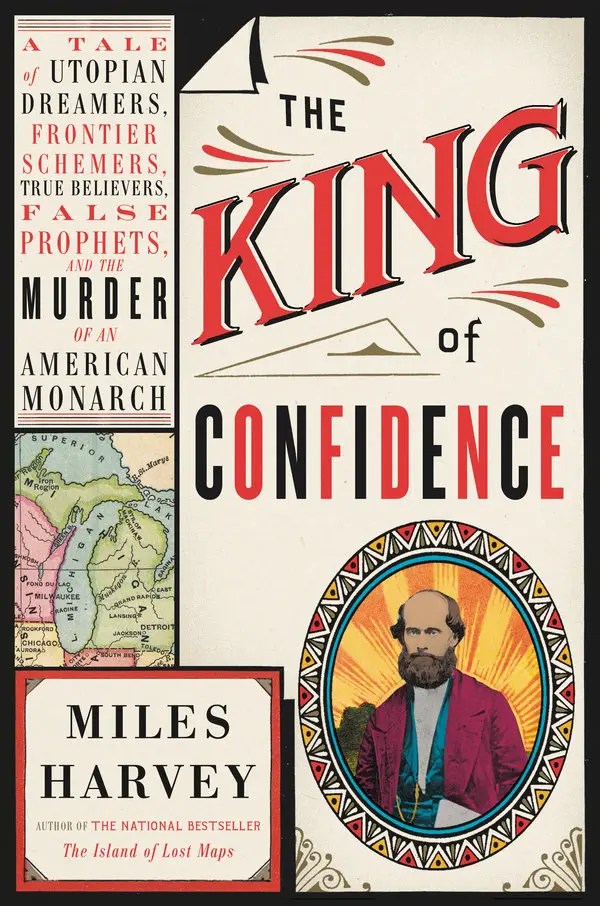
One of the aspects that drew me into this book compared to others that I have read about Strang and the history of Beaver Island was its contextualization of Strang’s story within the broader historical landscape. Harvey captures the societal upheavals of the time, such as the Second Great Awakening and the nation’s westward expansion. He showcases how Strang’s magnetic personality and messianic aspirations tapped into the spiritual hunger of the era, making his message of hope and divine providence all the more compelling to his followers.
As Strang’s power and influence grow, so does the tension within the community he builds. Then comes the complex power dynamics, as well as the simmering tensions between Strang’s followers and the outside world — which ranged from Beaver Island residents and other settlers in the Great Lakes region, all the way to Washington, D.C. The book’s pacing crescendos toward the inevitable clash between Strang’s kingdom and the outside forces that challenge his authority, culminating in an act of violence that forever alters the course of the Beaver Island experiment.
The transformation of Beaver Island into a theocratic monarchy highlights the division between religious idealism and the pragmatic realities of governance. Strang faced considerable challenges as he sought to balance his claimed spiritual convictions with the practicalities of leadership, and the book provides a window into the intricacies of a utopian society on the fringes of the American frontier.
Ultimately, The King of Confidence is an engrossing exploration of a forgotten chapter in American and Michigan history. In an era where history often overlooks the voices on the periphery, The King of Confidence resurrects a narcissistic, charismatic leader and the world he created.
Surely if someone as unremarkable as James Strang presented him or herself as a powerful visionary in today’s political scene, we would have the basic cognition to see through their facade, right? Harvey offers modern society a word of caution:
“Eventually the facts of his life faded into obscurity. But people like James Strang never really vanish. When the time is right, they reappear, wearing a new guise, exploiting new fears, offering new dreams of salvation. Americans are fixated on such figures, especially in periods of profound social and economic upheaval.”
In the words of famed American author Mark Twain, “History never repeats itself, but it does often rhyme.”
Perhaps when the time comes, we will be wise enough to heed Harvey’s and Twain’s words.

 ED A. MURRAY
Leave a reply to Sam “Goldie” Kirk Cancel reply